Skip to content
Koek GmbH
Menu
Reachability

VoIP and business telephony that stays reachable every day

Business telephony should work reliably, sound clear and fit daily operations. For practices, care providers and regulated organizations, that means more than replacing old phone lines. It means reachable teams, structured call handling, secure administration and a setup that still works when locations, staff or workflows change. We plan, implement and operate VoIP and business telephony in a practical way for organizations in Hamburg that need dependable communication without unnecessary complexity.

Schwerpunkte

Aligned with network, devices and call handling logic
Migration from legacy PBX with controlled cutover and numbering plan
Supportable configuration instead of improvised one-offs

Typical starting point

Many organizations come to us when their current phone system no longer fits how they actually work. Calls are missed, call routing is unclear, remote staff are hard to integrate, or changes depend on a single provider and take too long. In practices and care environments, this quickly affects patient communication, coordination and internal availability. A modern VoIP setup can solve these issues, but only if it is designed around real processes, opening hours, responsibilities and escalation paths.

VoIP telephony built around operations

We design business telephony around your day-to-day work: incoming calls, queues, groups, handovers, voicemail, time-based routing and location-independent availability. The goal is not a feature-heavy system for its own sake, but a setup that helps your team answer faster, route calls correctly and stay reachable across desks, mobile devices and multiple sites. Where needed, we align telephony with existing IT, Microsoft 365 environments and operational requirements.

From assessment to operations

We start with an assessment of your current telephony, connectivity, users, locations and call flows. Based on that, we define a target setup, migration path and responsibilities. We then handle implementation, number porting coordination, device rollout, testing and go-live planning. After launch, we continue with administration, changes, troubleshooting and operational support. This gives you a clear transition from legacy telephony or fragmented setups to a managed business communication environment.

How this service looks in practice

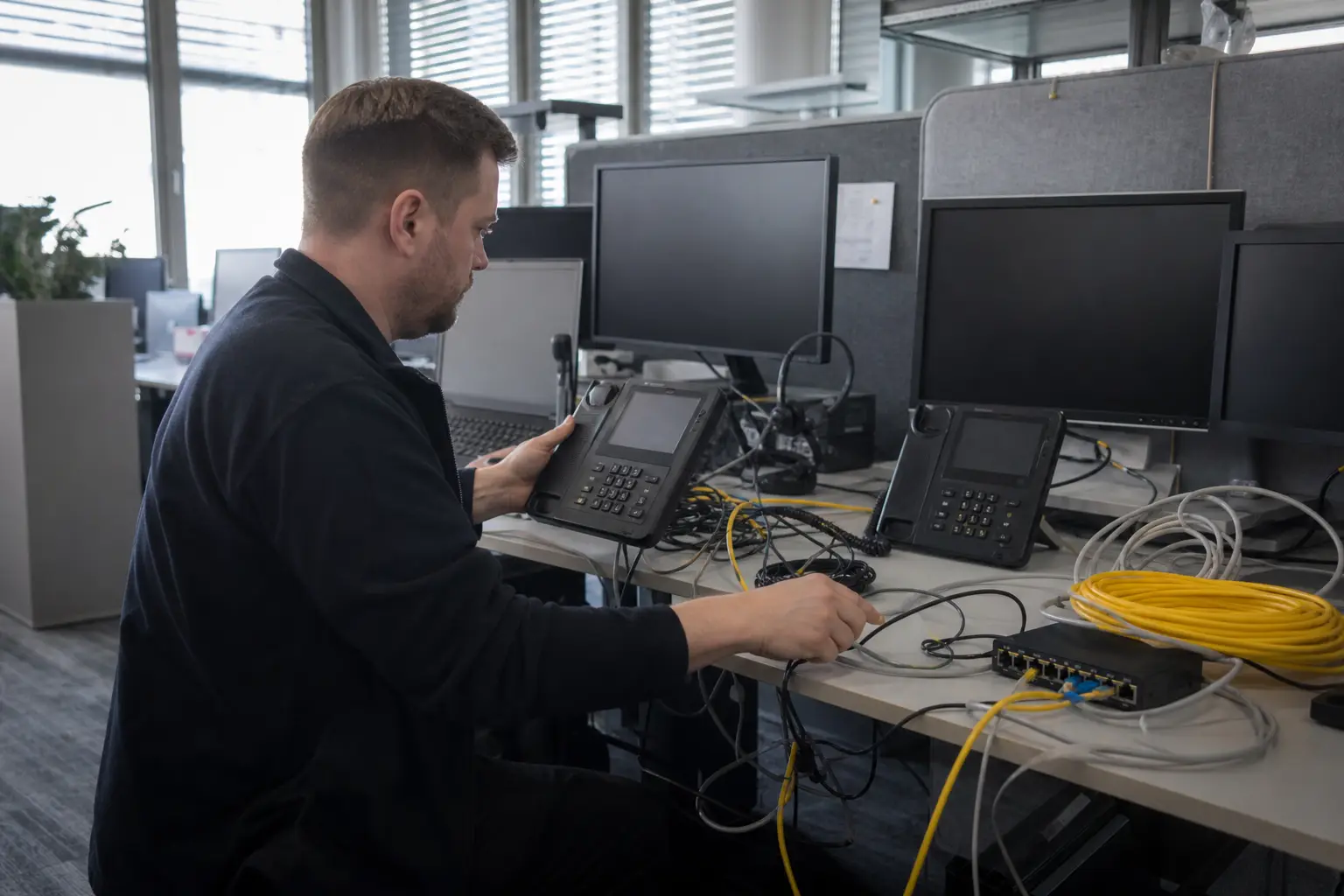
In practice, this often includes structured call groups for reception and teams, opening-hour rules, failover concepts, softphones for mobile work, desk phones where needed and clear administration processes for adds, moves and changes. For practices and care services, we pay particular attention to reliable reachability, simple handling for staff and stable operation across everyday workload. The result is a telephony setup that supports service quality instead of creating friction.

Suitable for practices, care providers and regulated SMEs

Healthcare-related organizations often need telephony that is dependable, easy to manage and aligned with operational reality. Reception, scheduling, patient communication, coordination with external parties and distributed teams all place different demands on call handling. We support practices, MVZs, care providers and other regulated SMEs with VoIP environments that are structured, maintainable and integrated into the wider IT landscape.

Why managed telephony matters

A phone system is not finished after installation. Teams change, opening hours change, devices need replacing and call flows need adjustment. Managed telephony means these changes are handled in a controlled way, with clear ownership and support. It also means telephony is considered as part of your wider IT operations, including network stability, user management, endpoint setup and continuity planning.

Operational outcomes

  • • More reliable communication in daily work and during disruptions
  • • Less friction during PBX changes, rollouts and site changes
  • • Better visibility into numbers, routing and ownership

Scope of delivery

  • • VoIP concept for call groups, queues and sites
  • • Migration or new telephony platform rollout
  • • Alignment with network, security and workplace requirements
  • • Documented numbering, routing and fallback logic

Best fit

Businesses with multiple teams, call groups or sites
Practices and healthcare organisations with high call volume
Organisations preparing for a PBX change, carrier migration or new site structure
Approach

From assessment to operations

01

Define the target state

We clarify scope, timeline, dependencies and approvals with the responsible stakeholders.

02

Technical design

Architecture, migration path, test windows and rollback strategy are aligned before implementation.

03

Controlled rollout

Implementation happens in defined stages with communication, testing and acceptance.

04

Stabilisation

After project completion we stabilise operations, close remaining items and hand over into steady-state support.

Case study

How this service looks in practice

FAQ

Questions about this service

Relevant next steps

Related pages with strong fit

Next step

Review this service in your context

Planning a new phone system or replacing an outdated setup? Talk to us about a VoIP environment that fits your operations and stays manageable in daily use.