Skip to content
KOEK GmbH
Menu
Resilience

Backup and recovery that holds up in a real incident

A backup is only useful if systems and data can be restored quickly and in the right order when something actually goes wrong. We design backup and recovery environments for care services, medical practices, healthcare organisations and regulated SMEs that need reliable operations, clear priorities and practical recovery procedures. The focus is not just on storing copies of data, but on restoring critical systems in a controlled way after ransomware, hardware failure, user error or infrastructure disruption.

Focus areas

Restore testing instead of false confidence from green jobs
RPO and RTO align with real operational needs
Technical backup and emergency logic are planned together
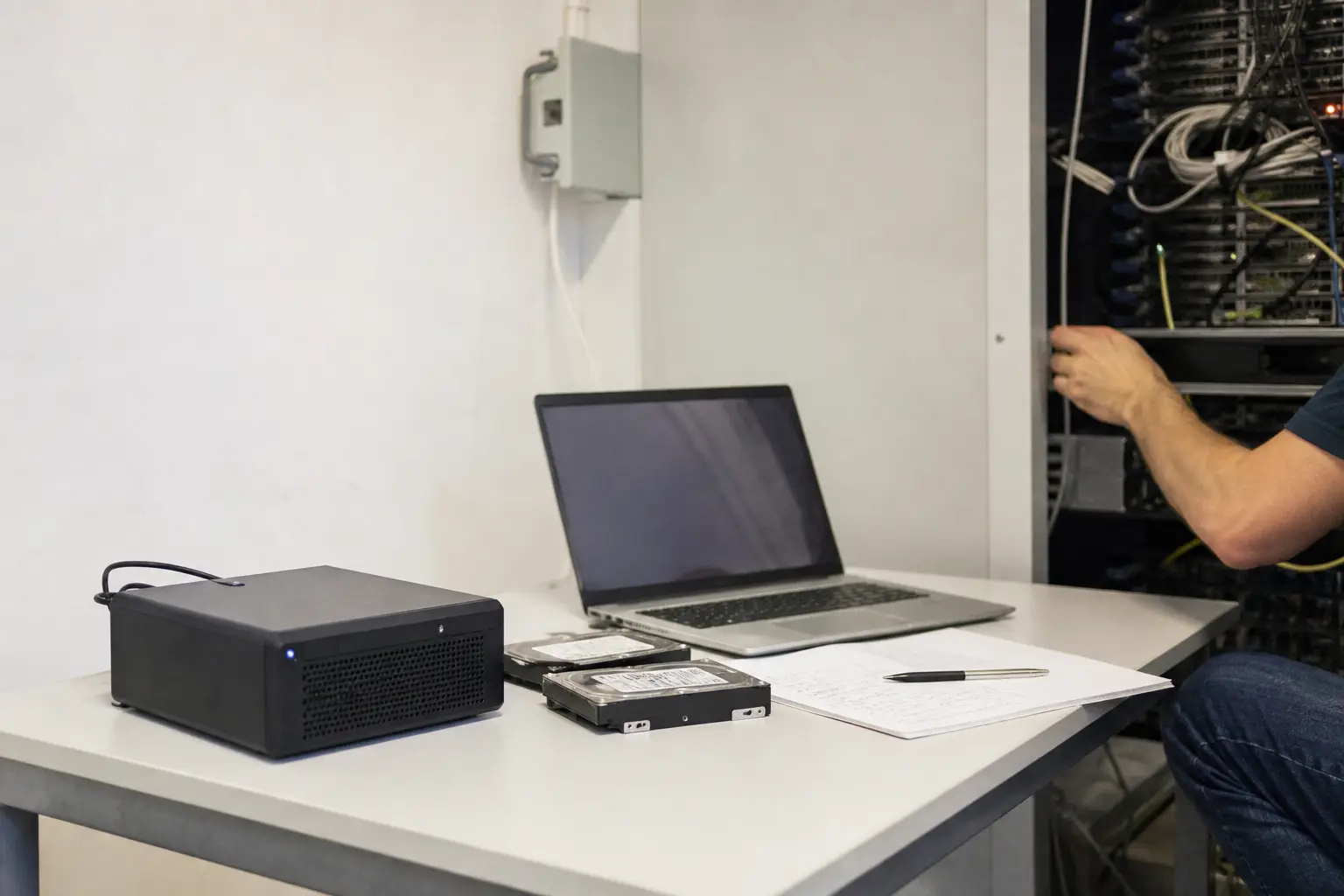
Workstation prepared for a practical backup and recovery test.

Typical starting point

Many organisations already have some form of backup in place, but the real risks often remain unclear. Backups may run without regular restore tests, retention may not match operational or regulatory needs, and dependencies between servers, cloud services, applications and endpoints are often undocumented. In practices and care environments, this becomes critical quickly: patient-related systems, documentation, communication and billing processes cannot stay unavailable for long. We start by reviewing what is protected today, which systems are actually business-critical, how recovery would work in a real incident, and where technical or organisational gaps exist.

From assessment to stable operations

Our work usually begins with an assessment of systems, workloads, backup scope, retention logic and recovery requirements. We define which data and services need which level of protection, how quickly they should be available again, and in what order recovery should happen. Based on that, we design or improve the backup setup, align storage and recovery paths, and establish practical monitoring and documentation. Where needed, we integrate Microsoft 365 data protection, server and endpoint backup, and recovery planning for hybrid environments. The goal is a setup that is understandable, testable and maintainable in day-to-day operations.

How this service looks in practice

In practice, backup and recovery means more than a tool running in the background. We structure backup jobs around operational priorities, separate critical from less critical workloads, and define restore procedures for realistic scenarios. We check whether backups are complete, whether recovery points are usable, and whether the organisation knows what to do under pressure. For healthcare-related organisations, this often includes prioritising line-of-business systems, file services, identity components and communication platforms so that core care and practice operations can resume first. Restore testing is a key part of this work, because recoverability should be proven, not assumed.

Built for healthcare and regulated operations

Care providers, practices and healthcare organisations work under operational pressure and with sensitive data. Downtime affects not only productivity, but also patient care, scheduling, documentation and coordination across teams. Backup and recovery therefore need to reflect real operating conditions: limited tolerance for interruption, clear responsibilities, and dependable recovery paths. We help align technical backup design with the realities of healthcare operations, including distributed teams, mixed on-premises and cloud environments, and systems that cannot simply be rebuilt from scratch.

What we typically cover

Depending on the environment, our service can include backup strategy, workload classification, retention planning, backup architecture, Microsoft 365 backup, server and virtual machine backup, endpoint protection, restore testing, recovery runbooks, monitoring and operational support. We also help clarify which systems are essential for first-stage recovery and how emergency logic should work if not everything can be restored at once. This creates a more resilient operating model and reduces uncertainty during incidents.

Why restore logic matters

In a real incident, the main question is rarely whether a backup exists. The real question is what can be restored first, how long that takes, and what dependencies must be available for users to work again. A file server may depend on identity services. A business application may depend on a database, network access or specific user permissions. Without defined recovery logic, organisations lose valuable time during an already stressful situation. We help turn backup from a passive safeguard into an active continuity measure with clear sequencing and decision-making.

Operational outcomes

  • • Lower outage risk during failures, attacks or operator mistakes
  • • Clearer roles for IT, business teams and escalation during an incident
  • • Better auditability for backup, retention and recovery

Scope of delivery

  • • Backup architecture for servers, endpoints and cloud data
  • • Restore tests with documented results and learnings
  • • Emergency runbooks and escalation paths
  • • Alignment of retention, protection classes and ownership

Best fit

Care providers relying on documentation and scheduling systems
Practices and MVZ organisations with patient-facing applications
Businesses that need to connect backup with real recovery readiness
Approach

From assessment to operations

01

Assess the risk posture

We prioritise protection needs, attack surfaces and critical systems based on the real operating environment.

02

Design the controls

Policies, hardening, MFA, network segments and response paths are aligned into one coherent control model.

03

Implement technically

We implement controls close to production and validate them together with the customer team.

04

Operate continuously

Monitoring, updates, awareness and incident readiness stay in place as an ongoing operating layer.

Case study

How this service looks in practice

FAQ

Questions about this service

What is included in backup and recovery services?

Typically this includes assessment of current backups, definition of critical systems, backup design, retention planning, monitoring, restore testing and practical recovery procedures. The exact scope depends on your environment and operational requirements.

Do you support Microsoft 365 backup?

Yes. Where required, we include protection and recovery planning for Microsoft 365 data alongside servers, endpoints and hybrid infrastructure.

How often should backups be tested?

That depends on the criticality of the systems involved, but restore testing should be part of regular operations rather than a one-time project. The important point is to verify that recovery actually works under realistic conditions.

Can you help after a ransomware incident?

We can support recovery planning and restoration work depending on the situation and the available backup state. The priority is to understand what is intact, what can be restored safely and how to bring critical services back in a controlled order.

Is this relevant for small practices and care providers too?

Yes. Smaller organisations are often especially vulnerable because they have limited internal IT capacity and little tolerance for downtime. A clear, tested backup and recovery setup is often one of the most important safeguards.

Do you only work with healthcare organisations?

No. Our focus includes care services, practices, MVZs and healthcare organisations, but we also support regulated SMEs that need dependable backup and recovery for business continuity.

Relevant next steps

Related pages with strong fit

Protection for critical data

Cybersecurity

Koek prioritises protection where data, systems and operational continuity are most exposed, and builds security levels that can actually be operated day to day.

  • • Reduced attack surface and less operational uncertainty
  • • More transparency about posture, weaknesses and residual risk
  • • A stronger basis for investment, prioritisation and governance decisions
Learn more →
Auditable structures

Compliance & documentation

When knowledge is spread across tickets, files and individuals, audits, handovers and security decisions become slow and risky. Koek structures documentation, ownership, approvals and evidence so your IT operations become traceable and dependable.

  • • Auditable IT evidence instead of second-hand knowledge
  • • Faster handovers, onboarding processes and decisions
  • • More stable collaboration with service providers and internal teams
Learn more →
Regulated operations

Healthcare

In healthcare, working IT is not enough on its own. Systems need to be secure, documented and resilient in daily use, because outages, access errors or integration failures have direct consequences for care, administration and compliance evidence. Koek combines operations, security and data flows into one durable model.

  • • Patient-related or health-related data demands controlled access and clean evidence trails
  • • Specialist systems, communication, endpoints and infrastructure need to work together end to end
  • • Outages or security gaps have immediate consequences for operations, trust and compliance
Learn more →
Care IT

Care services

Care services work under time pressure, on the move and with sensitive documentation. When access fails, devices break down or specialist software is poorly integrated, routes, evidence and communication are hit immediately. Koek builds an operating model that reduces exactly that friction.

  • • Mobile staff need secure, simple and always understandable access
  • • Care software, email, devices and connectivity must work as one system
  • • Time-sensitive field work and documentation duties cannot tolerate long disruptions
Learn more →
Next step

Review this service in your context

Need a backup and recovery setup that works under real pressure? Talk to us about your current environment, critical systems and recovery priorities.

Services with a clear scope

Find the right IT package

Compare all packages

Backup & recovery

Organisations that need evidence of recoverability and clear recovery priorities.

  • Record data classes and backup objectives
  • Plan retention and separated copies
  • Test and document restoration

Unit: Protected system and data volume

Individual quotation

Retention, recovery time and recovery point objectives are agreed individually.

Quantities, setup, recurring charges, term and cancellation are set out in the written quote before you commit.

Request a non-binding quote